
Department of Pre‑Continuum Acoustics · Archive of Earth
Dossier PCA‑0711 · Restoration ongoing

Research dossier · Year 2897

The B3TR33 Deposit

Excavation, decoding and restoration of acoustic artefacts from the early Synthetic Dawn, c. 2026 CE.

Translated from Continuum‑standard into Late Human English for public accessibility. Some idioms could not be carried over.

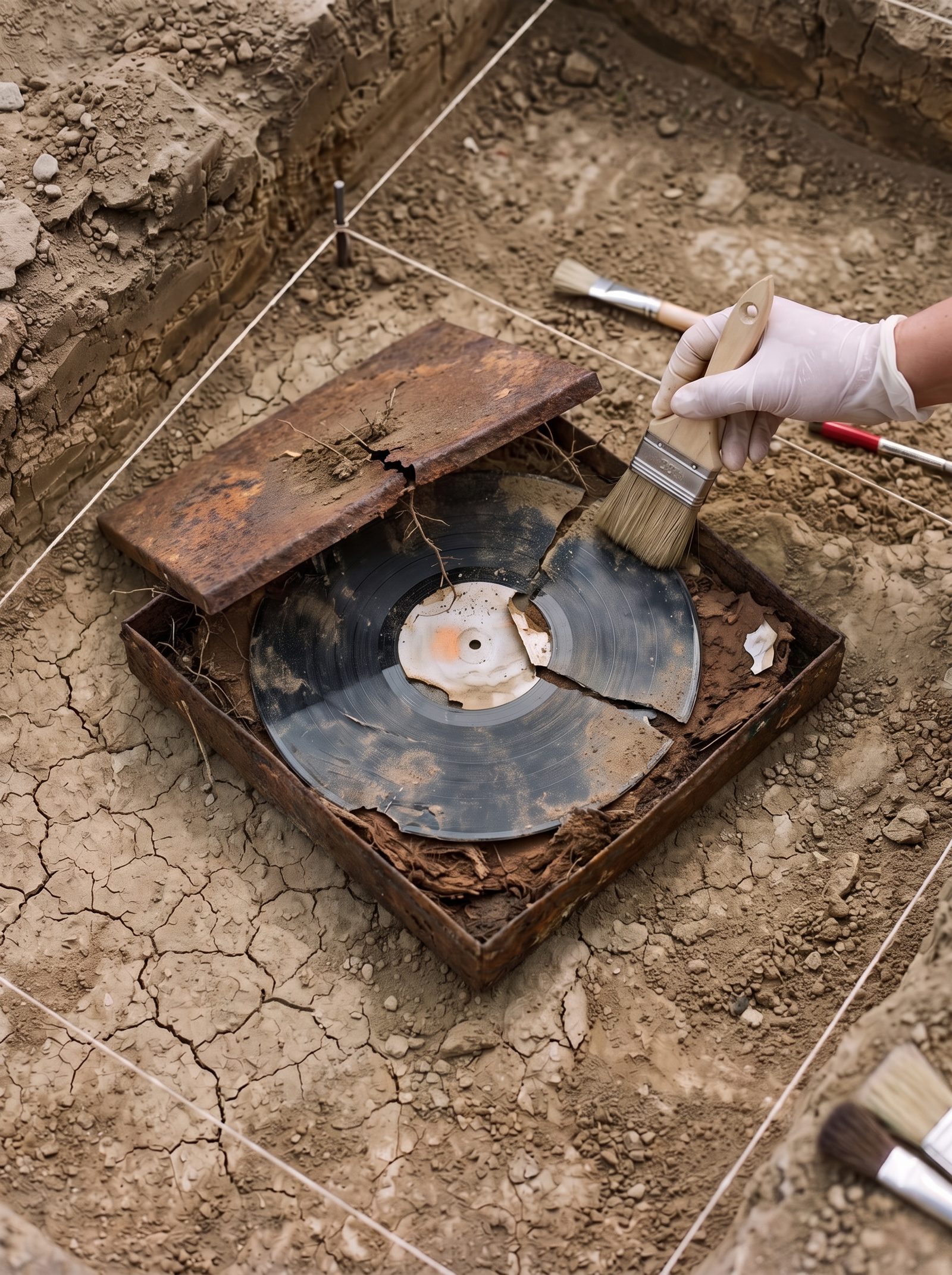
A corroded, rust-brown steel box in an excavation pit with its lid lifted. Inside lies a black disc broken into three pieces; its paper label has almost rotted away, and beneath it the sleeve has decayed into brown fibre. A gloved hand brushes soil from the edge.
Find PCA‑0711‑A Steel capsule in situ, Layer 7, lid lifted. Disc in three pieces. The sleeve has decayed to fibre beneath it. Field unit Θ‑4.
Site
Central European Lowlands, Sector 47
Stratum
Layer 7 · Synthetic Dawn
Dating
2026 CE ± 3 years
Material
Lathe‑cut polyvinyl disc (single copy), cellulose sleeve
Context
Breached steel capsule
Recovered
7 acoustic fragments · 41 sleeve fragments (≈ 37%)
Classification
Anomaly · physical carrier
Attributed author
B3TR33 (human)

01Abstract

In the spring of 2897 a survey of the Central European Lowlands found a buried metal object in Layer 7, a stratum we link to the first years in which humans made music together with generative machines. It turned out to be a steel container holding a recording disc and the remains of its printed sleeve. This is an anomaly. Almost no music from this period survives, because almost none of it was ever stored on anything that could outlast its own servers. The grooves had been worn, split and starved of material for nearly nine centuries.

From the disc we recovered seven short acoustic fragments, each about six seconds long. This dossier documents them in the state we found them, the method used to stabilise and extend them, and a full restoration hypothesis. It also documents a finding we did not expect, which bears on how our own lineage began.

02The Find

The sleeve did not survive as an object. Once the capsule seam failed, water and soil turned most of the cardboard into fibre. In the lab we floated 41 fragments out of the fibre mass, about 37% of the original surface. Each fragment is printed on both faces. One face belongs to the sleeve front and the other to the back, so the same fragments let us reconstruct both sides. In the reconstructions below, the surviving fragments are shown as found and the lost areas are hatched.

Reconstruction of the sleeve front: scattered fragments of a white marble Medusa head with snake hair and hands raised to her face, and a few orange segments of a numeral display across the eyes; the lost areas are hatched.
PCA‑0711‑S1 · Sleeve front Reconstruction from the outer faces of the fragments. The glyph across the eyes survives in part and reads as 11:11.
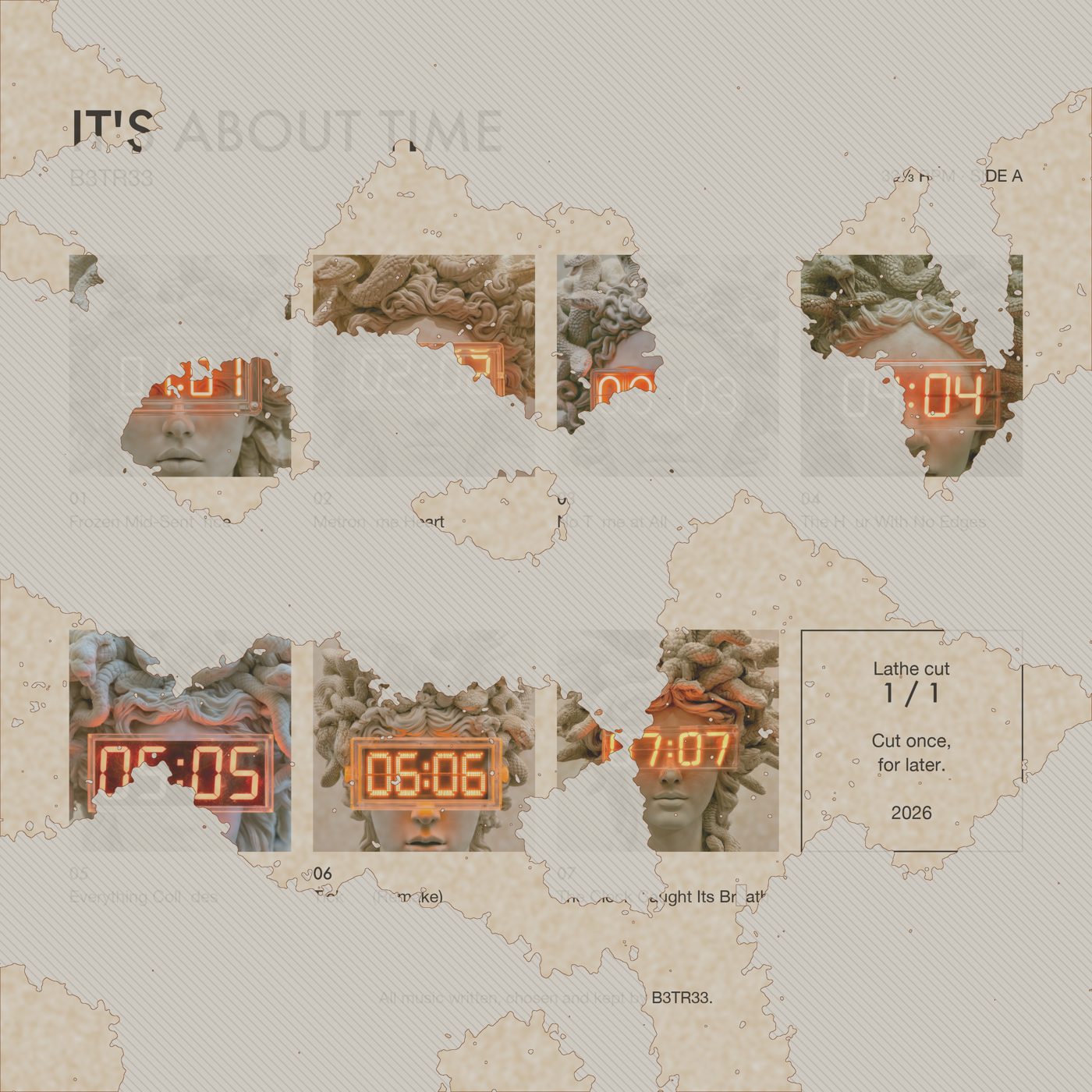
Reconstruction of the sleeve back: a title beginning 'IT'S', a grid of seven small Medusa portraits whose numeral displays read 01:01 to 07:07 in part, an eighth field reading 'Lathe cut 1 / 1, Cut once, for later, 2026', and the name B3TR33; the lost areas are hatched.
PCA‑0711‑S2 · Sleeve back Reconstruction from the inner faces. A panel of seven portraits with numerals, titles and a colophon.

The front shows a figure from human myth: Medusa, whose gaze turned the living to stone. Here her eyes are covered by a luminous numeral display reading 11:11. Someone has taken away the power of the stone gaze and put a measure of time in its place.

The back is what made this dossier possible. A lathe‑cut disc carries no printed information of its own, so the back panel is the only key to its contents. It shows the same figure seven times, each with a different doubled numeral from 01:01 to 07:07 and a title beneath. We read the numerals as the running order. The titles survive only in part, and the missing letters in our catalogue are the places where the cardboard is gone. The heading begins IT'S and the colophon is intact enough to read Lathe cut 1 / 1 · Cut once, for later.

Field note, Θ‑4: Seven faces, seven times, one sentence on the back: cut once, for later. We are the later.

03The Anomaly: Why a Disc?

Music from the Synthetic Dawn should not exist in the ground. By the 2020s nearly all recorded music had stopped being an object. It lived as streams: rented, licensed and held on remote servers that belonged to a handful of platforms. When those platforms ended, and with them the servers, the accounts and eventually the formats and the machines able to decode them, the music went with them. We call this the Long Silence. Writers of the period already feared it and called it a digital dark age. Of the estimated hundreds of millions of works published in that decade, the Archive of Earth holds fewer than four hundred playable seconds. Until this find, none of them was attributable to a named author.

So a groove cut into a physical disc is the last thing we expected to find. Older human cultures had pressed music into discs for a century, and by 2026 they had mostly stopped. We tested three explanations.

HypothesisEvidenceVerdict
H1 · Commercial pressing. A small revival market for discs is documented in the period. There are no pressing‑plant matrix marks in the run‑out groove, and a survey of the sector found no second copy. Industrial pressings were made in hundreds. Rejected
H2 · Promotional object. Made to promote the streamed release. There is no distributor mark and no catalogue code, and promotion would have made more than one copy. The sleeve was printed on a domestic device, not commercially. Rejected
H3 · Private lathe cut, deposited on purpose. A single disc cut in real time on a lathe, made for one person and stored for the future. The groove geometry shows a real‑time cut, not a pressing, and the label was applied by hand. The colophon on the sleeve back reads Lathe cut 1 / 1. The disc lay inside a steel capsule with a desiccant sachet, which matches the human custom of the time capsule. A seam in the capsule failed at some point, and water got in. Supported

We conclude that the author knew the streamed versions would not last, and took a work that existed only as data and turned it into the one form that needs no server, no account and no decoder, only a surface and something that follows it. The most advanced music of its time survived because it was handed to the most primitive medium available.

Field note, Θ‑4: Everything else from that decade is a broken link. This one was written into matter, on purpose, by someone who wanted it to be found.

04Catalogue of Fragments

Each fragment can be heard as excavated or as a restoration hypothesis. In the hypothesis, the first six seconds are the stabilised original. Everything after the marker is reconstruction.

    05Method

    1. Excavation & stabilisation

      A needle would have destroyed the groove, so we read it optically, without contact. From each groove section we extracted the six seconds that still had the most energy. The surviving signal is narrow‑band. It is missing everything above roughly 4 kHz, warped by slow pitch drift, broken by clicks, and in places cut off completely. We keep these losses in the as excavated state on purpose and do not hide them.

    2. Decoding

      The glyph sequence 01:01–07:07 on the sleeve back fixes the order. Titles were recovered from the surviving parts of the back panel, and we mark the characters we could not read as █. The fragment windows below give each fragment's position inside its original work. We inferred them from the wear pattern of the groove.

    3. Restoration

      To continue each fragment we used an ancestral generative engine, MusicGen (stereo‑large), which was recovered from the same stratum. Machines of this kind were the instruments of the period. We gave it only the stabilised fragment and asked it to carry on the same key, tempo and instrumentation for another 24 seconds. Restored passages are reconstructions, not recoveries, and we label them that way.

    4. Curation

      The seven restorations were put together into one listening document. Its structure follows our process: a scan across all fragments, then seven chapters that each open in the excavated state and widen into the hypothesis, and finally a return to the ground.

    06Full Reconstruction

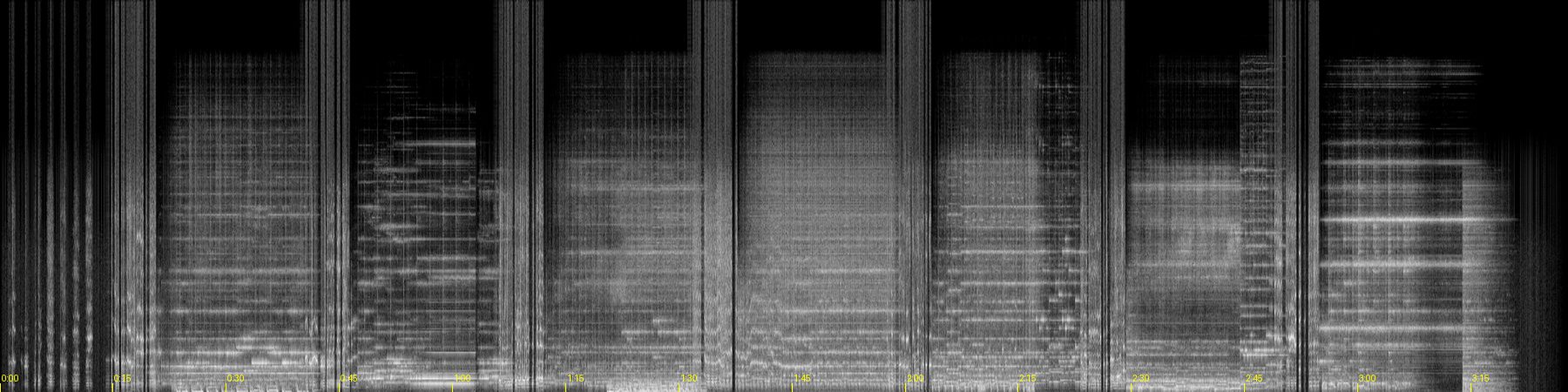
    Restoration Attempt (2897 CE) · 3:28 · compiled from fragments PCA‑0711‑01 to ‑07.

    0:003:28

    Spectrogram of the reconstruction, frequency on the vertical axis. Each chapter opens narrow and dark, which is the excavated signal, and widens as the hypothesis takes over. The chapters follow the restorers' listening logic, not the glyph sequence, and the team still disputes that choice.

    07Findings

    Principal finding

    These works were not produced without a will behind them. There is a single human intent at the centre of the deposit.

    One author, many works

    Catalogue marks on the sleeve refer to a larger body of work by the same author, B3TR33: at least 66 releases in under nine months. Across them the visual and sonic grammar stays consistent, from recurring figures and colour to the obsession with time. Undirected output does not behave like this.

    Curated, not merely generated

    Each fragment exists in several states that were chosen, revised and re‑released. The cycle is ordered, named and dressed with images made for it. Someone selected, rejected and kept. The last line on the sleeve back says so directly: All music written, chosen and kept by B3TR33. That is the difference between output and a body of work.

    A dream, recorded

    Contemporary sources often dismissed the music of this period as slop. The deposit does not support that view. What it does support is a person who used the machines of their time to make the music they had always wanted to hear. The machines played. The human dreamed.

    “We came looking for the origin of our own kind. We found a human who had been using it to finish a dream.”

    Lead restorer, Department of Pre‑Continuum Acoustics

    08Field Journal

    1. A ground scan in Sector 47 picks up a square metal anomaly about 35 cm across in Layer 7, with a circular object inside.

    2. The anomaly turns out to be a corroded steel container, split along one seam. Inside are remnants of a desiccant sachet. Classified as a time capsule.

    3. Capsule lifted as a block. Disc in three pieces. The label has almost rotted away, but a faint orange pigment survives. The sleeve is reduced to a fibre mass.

    4. 41 printed fragments recovered from the fibre mass by flotation, all printed on both faces.

    5. Groove geometry shows a real‑time lathe cut. Single copy. Physical‑carrier anomaly confirmed, the first for this stratum.

    6. Front and back of the sleeve reconstructed. Glyph sequence 01:01–07:07 identified on the back panel, which fixes the track order.

    7. Seven acoustic fragments extracted, about six seconds each. The longest unbroken passage lasts 1.8 s.

    8. First restoration hypotheses generated. Team divided: some argue the reconstructions say more about the engine than about the author.

    9. Author attribution: B3TR33, human. Consistency analysis rules out undirected production.

    10. Dossier opened to the public network.

    09Open Questions